

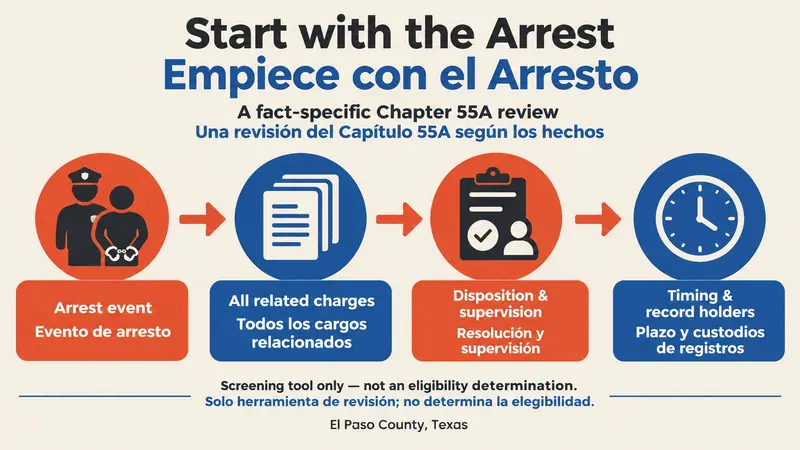
A Texas expunction eligibility review begins with the arrest, not merely the charge that appears most important on a docket. Under current Texas Code of Criminal Procedure Chapter 55A, eligibility can turn on the disposition, offenses from the same transaction or criminal episode, and statutory timing. A dismissal matters, but it does not decide every case.
Traffic Tickets 915 provides focused record-clearing reviews for people in El Paso County and nearby Horizon City, Socorro, San Elizario, and Canutillo. This is general legal information as of September 2026, not individualized advice. An accurate petition starts with the arrest, charging, dismissal, and court history before filing.
Eligibility starts with the entire arrest transaction
Chapter 55A addresses records and files relating to a custodial or noncustodial felony or misdemeanor arrest. A screening should identify the arrest date, agency, county or municipality, allegations, case numbers, and later charging decisions. The final disposition of one count can hide a related felony allegation or another offense that changes the analysis.
For common no-conviction pathways, the person generally must have been released, have no final conviction or pending charge, and have received no court-ordered community supervision for the offense other than for a Class C misdemeanor. Trial-court acquittals, qualifying pardons, certain specialty-court or pretrial-intervention outcomes, mistakes or void charges, and mistaken identity have separate routes. Match the statutory route to the documents, not a “case dismissed” label.

No charge, dismissal, acquittal, and conviction are different routes
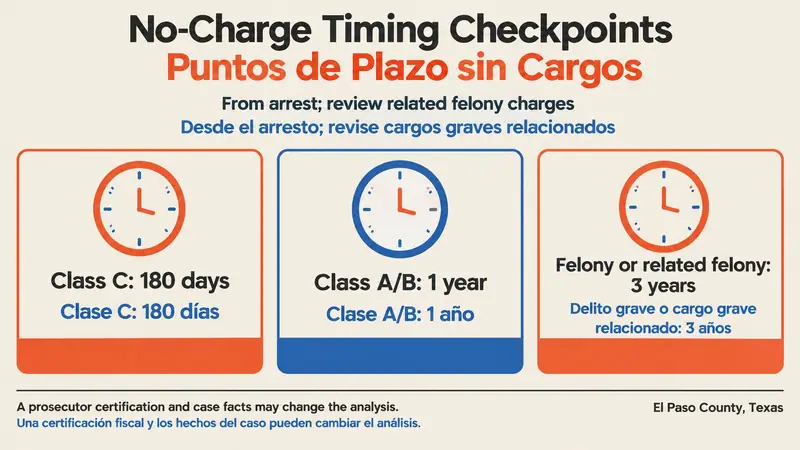
If an indictment or information was never presented, Article 55A.052 supplies a timing path: 180 days from arrest for a Class C misdemeanor with no related felony charge; one year for a Class A or B misdemeanor with no related felony charge; or three years for a felony arrest or a transaction involving a felony charge. A prosecutor certification that records are not needed for an investigation or prosecution can create another route. The rule applies whether a limitations period exists or has expired.
When a charge was presented and later dismissed or quashed, the reason matters. Article 55A.053 identifies particular grounds, including qualifying pretrial intervention, certain veterans or mental-health court completions, a presentment based on mistake or false information showing no probable cause at dismissal, or a void charging instrument. An ordinary dismissal does not automatically establish that category. If prosecution is no longer possible because limitations expired, Article 55A.054 is another possible route. A completed sentence, regular probation, or final conviction requires a different analysis, often including nondisclosure.

Related charges can control the result and the clock
Texas expunction law is not safely applied count by count. For the no-charge rules, Chapter 55A asks whether a misdemeanor charge based on the arrest or any felony charge arising from the same transaction was presented. A connected felony can change the waiting period. Compare the arrest narrative, offense dates, charging instruments, grand-jury action, and docket history rather than rely on a criminal-history summary alone.
Article 55A.151 bars expunction of an acquittal-related arrest when the acquitted offense arose from the same criminal episode as another offense for which the person was convicted or remains subject to prosecution. Other limits matter: an arrest on a community-supervision-violation warrant is not expungable under these subchapters, and a person who intentionally or knowingly absconded after release is excluded from specified timing and limitations paths. Driver-license suspension or revocation records are not expunged under Chapter 55A except under applicable Transportation Code provisions.
Timing, records, and venue should be mapped before filing
A verified petition ordinarily belongs in a district court in the county where the person was arrested or where the offense was alleged. For a fine-only arrest, a justice court or municipal court of record in the same county may have authority. In an El Paso County matter, the District Clerk identifies electronic-filing options and expunction materials. Confirm local fees and delivery costs with the clerk because they can change and may depend on entities needing notice.
The petition must contain extensive identifying and case information, or explain what is unavailable. It also must identify relevant governmental entities and may identify federal repositories or private criminal-history companies the petitioner has reason to believe possess records. The court sets a hearing no earlier than 30 days after filing. Gathering records early avoids guessing about agencies, dates, jail records, municipal-court activity, or a related case from another court.
- Gather the arrest report, charging instrument, docket sheet, disposition records, and applicable program-completion proof.
- Create one timeline from arrest through release, charging, dismissal, trial, supervision, or the relevant statutory period.
- Check every offense from the same transaction or criminal episode, including any pending or resulting in conviction.
- Identify likely record holders: arresting agency, jail, prosecutor, court, clerk, DPS, and known private background companies.
- Confirm the El Paso court, filing method, notice costs, hearing date, and approaching deadline before filing.
A final order has powerful effects, but not limitless ones
When a Chapter 55A expunction order under the general procedures is final, state law prohibits release, maintenance, dissemination, or use of the expunged records and files, and ordinarily permits the arrested person to deny the arrest and order. If questioned under oath in a criminal proceeding about that arrest, however, the person may state only that the matter was expunged. Accurate agency and record identification remains important.
An expunction is not a promise that every trace vanishes everywhere or immediately. Chapter 55A allows or requires limited retention in defined circumstances, including records needed for a potential prosecution, certain acquittal-related investigations or cases, and records tied to no-charge waiting periods without a prosecutor certification. Federal, immigration, licensing, security-clearance, private-data, and out-of-state questions can involve separate rules or systems. Keep a certified signed order and seek tailored advice before a sworn or federally required disclosure.
FAQ
Frequently asked questions
Can I expunge a dismissed charge in El Paso County?+
Possibly, but a dismissal alone does not decide eligibility. The screening must confirm the statutory basis for dismissal, whether every related offense is resolved, whether there was disqualifying supervision or a conviction, and whether another Chapter 55A route such as expiration of limitations applies. The petition venue may be El Paso County if the arrest or alleged offense occurred there.
How long do I wait if no charges were filed?+
Article 55A.052 states 180 days from arrest for a Class C misdemeanor with no related felony charge, one year for a Class A or B misdemeanor with no related felony charge, and three years for a felony arrest or a same-transaction felony charge. A prosecutor certification that records are not needed may change the timing analysis. Verify the actual arrest classification and all related allegations.
Can I expunge only one charge from an arrest with multiple charges?+
Often, the statutory question is broader than one charge. Same-transaction and criminal-episode rules can block or delay relief where another offense remains prosecutable or resulted in conviction. A review should examine the entire arrest event, not just the count that was dismissed or produced an acquittal.
Will an expunction clear my driver’s-license suspension or DWI-related record?+
Do not assume so. Chapter 55A says records relating to a driver’s-license suspension or revocation are not expunged under that chapter except as provided in specified Transportation Code sections. Criminal, administrative-license, court, and DPS records may require separate analysis. The facts of a DWI-related matter can also affect whether expunction or another remedy is available.
Do I have to disclose an expunged arrest?+
Texas law generally lets a person deny the arrest and expunction after a final qualifying order, subject to the criminal-proceeding-under-oath rule. That does not answer every federal, immigration, military, security-clearance, licensing, or sworn application question. Read the exact question and obtain individualized legal advice before signing or answering under penalty of perjury.
El Paso County record-relief help
Official Texas and El Paso resources
These official and nonprofit sources provide general information. Forms, fees, procedures, and statutes may change.