

After a Class C deferred adjudication, the first question is not simply whether the case was dismissed. It is whether the actual record fits Texas’s narrow Class C exception to the general rule that deferred adjudication does not qualify for expunction. A traffic citation, municipal-court summons, or fine-only misdemeanor can leave a record after court conditions are complete.
Traffic Tickets 915 helps people in El Paso County review that limited route. We compare the court paperwork, offense classification, related arrest information, and local filing steps, then explain practical next actions. This is general information, not a promise of eligibility or individualized legal advice. Request a review early when a job, school, license, immigration, or court deadline is near.
The Class C exception is narrow—and the paperwork controls
Texas expunction law is restrictive. In an ordinary deferred-adjudication case, successful completion and dismissal do not alone make the record expungeable. The important exception is a qualifying Class C misdemeanor deferred case. TexasLawHelp’s statewide guidance identifies Class C deferred adjudication as the deferred category that may be expunged, while the Code of Criminal Procedure supplies the controlling eligibility and petition rules. The charging and disposition records matter more than a memory that the matter was ‘just a ticket.’
Class C matters are often fine-only cases in municipal or justice court, where the court may say ‘deferred disposition.’ Other records may say ‘deferred adjudication.’ Neither label decides the question by itself. Review the offense level, final court action, completed terms, and whether the record arose from an arrest or court appearance. A court appearance on a ticket can count as an arrest event for expunction purposes under TexasLawHelp guidance.

Deferred disposition, deferred adjudication, and nondisclosure do different jobs
For a fine-only Class C case, a judge may defer the case while a person completes conditions such as a course, community service, or a compliance period. Completion can lead to dismissal. That is not an expunction. An expunction is a later statutory process concerning criminal-history and related records. A dismissed Class C deferred case may justify an expunction evaluation, but it is not automatically removed when the lower court closes its file.
Higher-level misdemeanor and felony deferred-adjudication cases are different. The Class C exception does not make every deferred case expungeable. Depending on the offense, dates, entire history, exclusions, and waiting rules, another deferred-adjudication case may call for a nondisclosure analysis instead. Nondisclosure is a separate Chapter 411 remedy. It generally restricts public disclosure, but authorized criminal justice, licensing, and certain government entities may still access the record.

A separate expunction petition needs complete facts and correct notice
An expunction is generally requested through a district-court petition; it is not obtained by asking the court that dismissed the Class C case to delete its file. TexasLawHelp directs people to file in the county where the arrest occurred or the alleged offense occurred. The petition must accurately identify the event and required officials, agencies, and entities. A wrong date, cause number, name variation, arrest description, or agency list can create delay or leave a record holder outside the order.
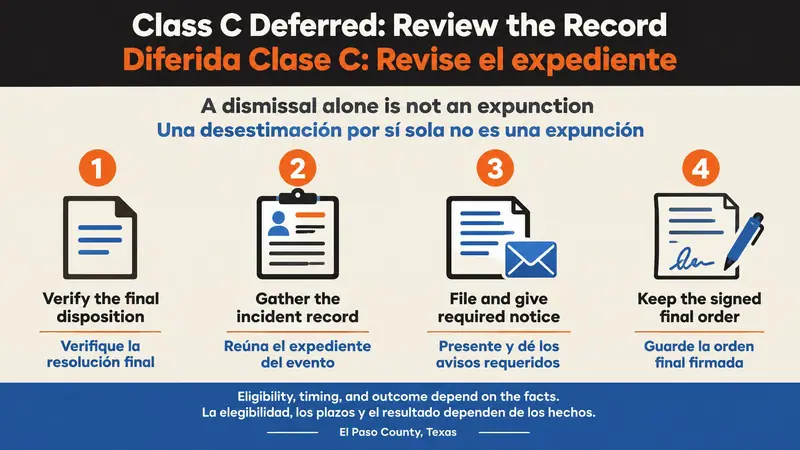
Gather the citation or complaint, charging document, docket, signed dismissal or discharge, proof of completed terms, and Texas criminal-history information. Check for other charges or allegations connected to the same event; the analysis is not limited to the preferred count on a search screen. Current Texas Judicial Branch materials provide that an expunction hearing cannot be set earlier than 30 days after filing. The judge decides the petition, so no ethical lawyer can guarantee an order.
- Obtain a reliable final disposition before relying on an online case-search screen.
- Record every name, date of birth, cause number, court, and arresting agency used in the file.
- Gather all charges and allegations tied to the incident, including dismissed or unfiled matters.
- Confirm the correct county, district court, agency list, filing method, hearing procedure, and current fees.
- Keep stamped filing copies and a secure copy of any final signed order.
El Paso County details deserve local attention
In El Paso County, expunction is among the civil matters handled by the District Clerk’s Civil Division at 500 E. San Antonio, Suite 103. The County points self-represented filers to EFile Texas Self Help, but clerk staff cannot give legal advice. They cannot decide whether a Class C deferred case qualifies or create the petition’s legal theory. Current filing methods, fees, and hearing practices should be confirmed before documents are submitted.
Local and state record holders may include the El Paso Police Department, El Paso County Sheriff’s Office, El Paso Municipal Court, County Clerk, District Attorney, County Attorney, District Clerk, and DPS. The required notice list turns on the particular event. Whether you live in central El Paso, Horizon City, Socorro, San Elizario, or Canutillo, preserve original court records. A local review can distinguish a municipal or justice-court outcome from a County Court or district-court matter needing a different analysis.
Know what a favorable order can and cannot solve
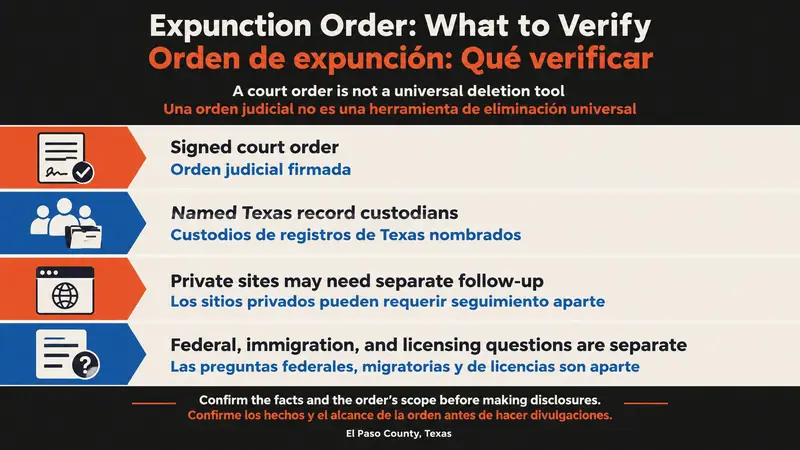
If a court grants an expunction and the order becomes final, listed custodians must handle records as the order requires. TexasLawHelp recommends checking a DPS criminal-history report about six months after a signed order and notes that record destruction can take longer. Keep a certified order in a safe place. Verification is sensible because multiple custodians process the matter; there is no single instantaneous database update.
An expunction is not a universal deletion tool. It does not force news media to remove reporting, and private data companies may retain old information that requires separate follow-up. It also does not resolve what a federal agency, immigration authority, licensing board, employer using non-Texas data, or private platform may possess or require. TexasLawHelp cautions that arrests must still be listed on immigration forms and disclosed to immigration officials. Call Traffic Tickets 915 before a deadline to review the Texas record issue and seek qualified immigration advice separately when needed.
FAQ
Frequently asked questions
Does every dismissed Class C case qualify for expunction?+
No. Dismissal is important, but it does not prove every statutory requirement. The offense level, type of disposition, arrest or court event, related charges, final paperwork, and statutory conditions require review. A matter called a ‘ticket’ may not state the complete legal history.
Is deferred disposition the same as deferred adjudication?+
They are commonly used differently. Fine-only municipal or justice-court cases often use deferred disposition; higher-level criminal cases often use deferred adjudication. The statute, court order, and actual record matter more than an informal label.
Can a Class A, Class B, or felony deferred case be expunged because it was dismissed?+
Usually, the narrow Class C exception does not extend to higher-level deferred-adjudication cases. A nondisclosure analysis may be appropriate for some people, but exclusions, waiting rules, and individual facts matter. Do not file an expunction petition based only on dismissal.
How long will an El Paso expunction take?+
There is no guaranteed timeline. Current Texas Judicial Branch guidance requires at least 30 days before an expunction hearing may be set after filing. Record collection, notice, a ruling, and order processing vary. TexasLawHelp suggests checking DPS about six months after a signed order.
Will an expunction erase every internet and background-check result?+
No. It has important Texas legal effects, but it cannot guarantee removal from every private, federal, immigration, licensing, media, online, or non-Texas system. Discuss the particular screening or disclosure question before making a representation about it.
El Paso County record-relief help
Official Texas and El Paso resources
These official and nonprofit sources provide general information. Forms, fees, procedures, and statutes may change.