

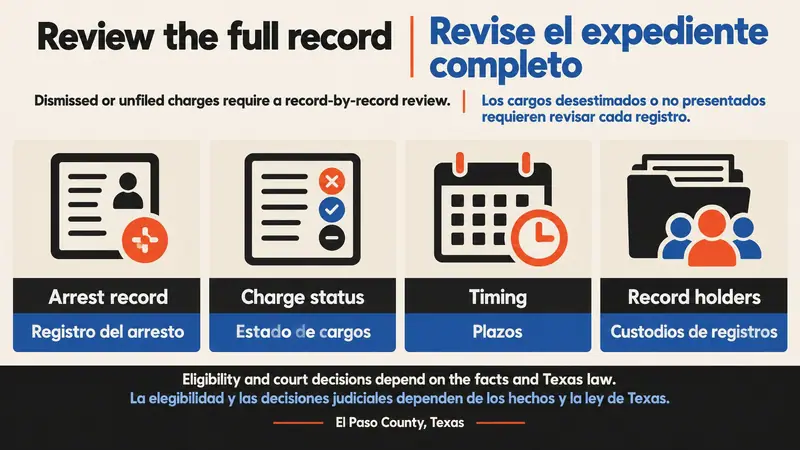
A review of dismissed charges should start with the arrest record, not a promise that a dismissal erased it. Texas expunction is an arrest-based remedy under Code of Criminal Procedure Chapter 55A. The path changes when charges were dismissed, when no indictment or information was presented, when a pretrial program was completed, or when another allegation arose from the same event.
Traffic Tickets 915 helps people in El Paso County organize the facts and assess an expunction petition. We can review the criminal-history entry, cause numbers, dismissal orders, limitations issues, and agency list. Eligibility and the court’s ruling depend on the actual record and statute; this page is general information, not individualized legal advice or a promised result.
A dismissal is important, but the statutory basis matters
For the principal dismissed-charge and no-charge provisions, Chapter 55A first requires release, no final conviction, no pending charge, and no court-ordered community supervision for the offense other than Class C misdemeanor supervision. A case dismissed after deferred adjudication is therefore not automatically an expunction case. The starting point is the full procedural history, not a docket label alone.
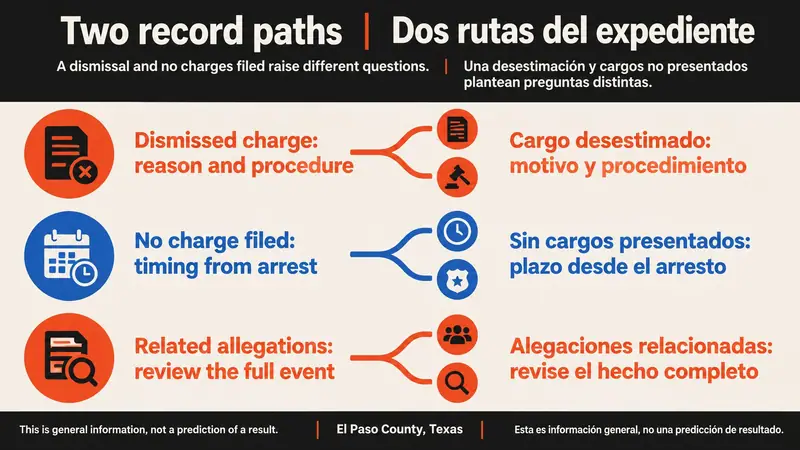
When an indictment or information was presented and later dismissed or quashed, Article 55A.053 provides a direct route only for specified grounds: qualifying veterans-treatment or mental-health-court completion, authorized pretrial intervention, mistake or false information indicating no probable cause at dismissal, or a void charging instrument. A routine dismissal may instead require the limitations period to expire. We examine the signed dismissal and related documents before identifying a route.

No charges filed: waiting periods and prosecutor certification
Article 55A.052 addresses arrests after which no qualifying indictment or information was ever presented. It sets minimum waits from arrest: 180 days for a Class C misdemeanor with no felony from the same transaction, one year for a Class A or B misdemeanor with no such felony, and three years for a felony arrest or an arrest involving a felony charge from the same transaction. These are statutory thresholds, not a guarantee of relief.
The waiting period may not control when the attorney representing the state certifies that the arrest records and files are not needed in any criminal investigation or prosecution, including one involving another person. That certification differs from a prosecutor’s recommendation. A state-attorney recommendation can support a discretionary request under Article 55A.101, but it does not assure an outcome. We can identify the record and agency facts to evaluate before seeking prosecutor participation.

Limitations and related charges can change the answer
For a dismissal that does not fit Article 55A.053’s specified grounds, Article 55A.054 can provide a route when prosecution is no longer possible because limitations has expired. Limitations are offense-specific. Formal charging and time outside Texas can affect the calculation, so a calendar count may be unreliable. Article 55A.053’s special dismissal grounds are different: entitlement there does not depend on whether limitations exists or expired.
A common risk is reviewing only the charge that seems most serious or was ultimately dismissed. The no-charge statute looks to misdemeanors based on the arrest and felony offenses arising from the same transaction. Multiple counts, a reduced charge, a rejected felony filing, a companion allegation, or a pending case can change the analysis. Review every accusation and disposition before asking a court to expunge records tied to an arrest.
Build an accurate El Paso County petition and record file
An expunction petition is verified and must supply detailed identifying and event information or explain what is unavailable. Article 55A.253 calls for name and aliases, date of birth, identifiers, address at arrest, alleged-offense and arrest dates, arresting agency, county or municipality, case number, court, and a properly targeted list of record holders. An eligible adult petition may generally be filed in district court in the county of arrest or alleged offense; fine-only matters have additional justice- or municipal-court options.
In El Paso, the District Clerk publishes an expunction form and fee information. Its current posted schedule lists a $350 filing fee and notes that notice costs can apply for agencies unable to receive electronic transmission; confirm requirements with the clerk before filing. The hearing cannot be set earlier than 30 days after filing. Incomplete agency details or an omitted charge can delay notice, invite a challenge, or leave records outside the requested order.
- Request the Texas DPS criminal-history record and preserve the tracking incident number (TRN) shown for the arrest.
- Obtain a certified dismissal order for every filed charge, plus docket or case information useful to verify the disposition.
- Collect arrest paperwork, bond or jail information, cause numbers, exact offense descriptions, and documents showing a pretrial program or qualifying prosecutor certification when applicable.
- Identify El Paso Police, the Sheriff, prosecutors, courts, DPS, and any other record holders reasonably believed to possess arrest-related files; verify current addresses and electronic-service details.
An expunction order has real reach, but not unlimited reach
If the court finds statutory entitlement, it directs expunction of the records and files covered by the petition and order. The order should identify relevant state and local entities, and Texas law directs DPS and the Texas Department of Criminal Justice to delete or redact applicable public index references in covered circumstances. Keep a certified copy after the signed order is filed. Processing time can vary, and a court order is not an instant change in every database.
Do not assume an order resolves every public, private, federal, immigration, licensing, or background-check issue. Private data companies may have prior copies and need separate contact; a petition can list known private entities, but it is not a universal cure. Federal immigration forms can require arrest disclosure even after expunction. Nondisclosure is different: it limits public disclosure while preserving access for certain agencies. A review should match the remedy and expectations to the person’s goal.
FAQ
Frequently asked questions
Can a dismissed charge be expunged in El Paso County?+
Possibly, but a dismissal alone is not enough. The analysis includes the dismissal reason, any pending charge, supervision history, every offense from the arrest, and limitations. Article 55A.053 gives specific dismissal-based routes; otherwise, expiration of limitations may be central. A district judge decides an eligible petition.
What if I was arrested but charges were never filed?+
Article 55A.052 may apply if no qualifying indictment or information was ever presented. The ordinary statutory wait is 180 days, one year, or three years from arrest depending on classification and related-felony facts. A qualifying state-attorney certification that records are not needed can change the timing analysis.
Do I need a prosecutor certification?+
Not in every case. It is an alternative route in the no-charge provision and must say the records and files are not needed for a criminal investigation or prosecution, including another person’s case. A certification and a discretionary prosecutor recommendation are different tools. Neither should be assumed available.
How long does the El Paso expunction court process take?+
The statute bars a hearing earlier than 30 days after filing. Total time depends on notice, agency service, the court docket, objections, corrections, and post-order processing. Traffic Tickets 915 does not promise a completion date; early record gathering can reduce avoidable delays.
After an expunction, can I say the arrest never happened?+
Texas law can allow denial in many settings after an expunction, but the exact question and legal context matter. Immigration authorities may require arrest disclosure, and prior private or federal records may raise separate issues. Do not rely on a broad statement for an application, licensing matter, or sworn proceeding without tailored advice.
El Paso County record-relief help
Official Texas and El Paso resources
These official and nonprofit sources provide general information. Forms, fees, procedures, and statutes may change.