

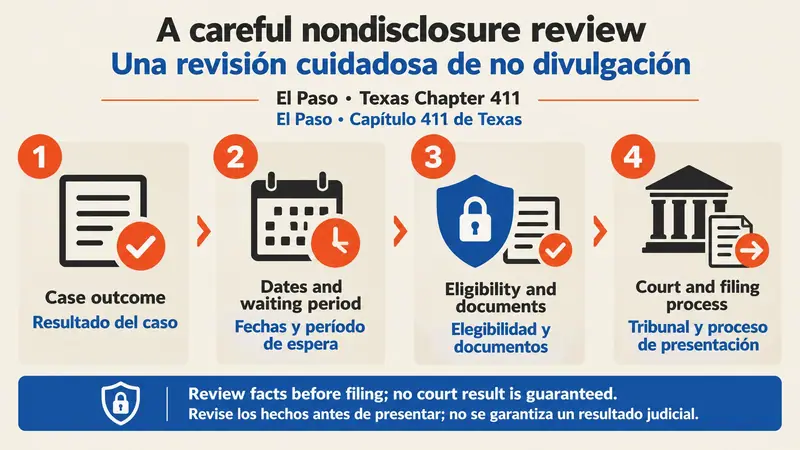
For an order of nondisclosure in El Paso, the key question is not simply whether a case was dismissed or supervision ended. Texas Government Code Chapter 411 has separate routes for deferred adjudication, selected convictions, DWI-related cases, veterans programs, and certain trafficking-survivor circumstances. A record from El Paso, Socorro, Horizon City, Canutillo, or elsewhere in El Paso County requires a review of the disposition, dates, and full criminal history before a request is prepared.
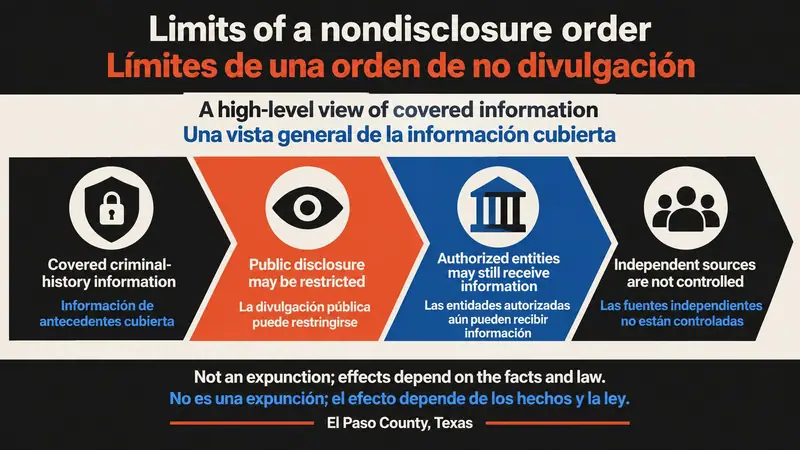
An order of nondisclosure is not an expunction. It generally limits public disclosure of covered criminal-history information, but does not erase every trace of an event or bar every recipient from seeing it. Traffic Tickets 915 can review the applicable route, documents, timing, and local filing steps without promising a court result or disappearance from every system.
What a Texas nondisclosure order can—and cannot—do
A nondisclosure order concerns criminal-history information for a particular offense. Under Chapter 411, it restricts public disclosure by criminal justice agencies of covered information. It is not a blanket seal for an entire history. Separate eligible offenses can require separate orders, and the route turns on the actual outcome: deferred adjudication and dismissal, a conviction with community supervision, or another disposition.
The distinction matters for employment, housing, school, and licensing questions. Texas law generally says a person whose information is covered need not state the related proceeding on an employment, information, or licensing application. Important limits remain: future criminal proceedings are different, and authorized governmental entities and licensing bodies may receive information. An order does not compel news outlets, independent data brokers, federal or immigration systems, or every private database to delete information.

Automatic and petition routes under Chapter 411
Section 411.072 is often called the automatic route. It is limited to a defined category of first-time, nonviolent misdemeanor deferred-adjudication cases, subject to exclusions and the shared Section 411.074 rules. For qualifying people discharged and dismissed on or after September 1, 2017, the court must determine eligibility and issue the order at dismissal if 180 days have passed since placement on deferred adjudication, or as soon as practicable after day 180.
Other pathways require a petition. Section 411.0725 addresses deferred-adjudication felonies and certain non-DWI misdemeanors outside the automatic category. Other sections address veterans treatment court, veterans reemployment, specified trafficking-survivor circumstances, and selected misdemeanor convictions. These routes may require notice to the state, a hearing, eligibility proof, and a best-interest-of-justice finding. The statute and form must match the exact disposition, not just the label “probation.”

Waiting periods, selected convictions, and DWI-related relief
Timing differs by section. A Section 411.0725 deferred-adjudication petition may be filed at dismissal for many misdemeanors, after two years for specified misdemeanor chapters, and after five years for a felony. For qualifying misdemeanor convictions, Section 411.073 may allow filing at completion of community supervision or, for listed chapters, after two years. Section 411.0735 covers certain other misdemeanor convictions. A new conviction or deferred adjudication during the relevant period can defeat eligibility except for a fine-only traffic offense.
DWI relief has special rules. A misdemeanor DWI or boating-while-intoxicated deferred-adjudication case may be petitioned under Section 411.0726 only after completion, dismissal, and a two-year wait; it requires evidence, no disqualifying history, and best-interest review. Qualifying DWI convictions may fall under Sections 411.0731 or 411.0736, with waits that can depend on a qualifying ignition-interlock condition. Elevated-BAC cases, another criminal history, or a collision involving another person can bar an order.
Eligibility review: records, disqualifiers, and a practical checklist
Section 411.074 supplies shared restrictions for most routes. A person cannot qualify if the requested offense, or a prior conviction or deferred adjudication, falls within listed categories: a sex-offender-registration offense, aggravated kidnapping, specified murder, trafficking, child-injury/endangerment, protective-order violation, stalking, or another family-violence offense. An affirmative finding that the requested offense involved family violence is independently disqualifying. The veterans reemployment provision has a distinct rule and must be screened separately.
A sound review compares statutory language with certified court papers and the full history, not memory alone. It also identifies a pending deadline, prosecutor-notice issue, or record needing correction before an El Paso County filing. Bring or request the materials below where available:
- Charging instrument, judgment, deferred-adjudication order, and signed dismissal or discharge order.
- Proof of completed supervision or sentence, including financial obligations.
- Current fingerprint-based Texas criminal-history report and prior-case details.
- Family-violence findings, ignition-interlock conditions, collision facts, and DWI paperwork.
- Case number, court, prosecutor, and agencies that may hold the record.
- A calendar of start and completion dates for the statutory wait.
El Paso County filing and what follows a court order
When a petition is required, Chapter 411 generally directs filing in the court that imposed deferred adjudication or community supervision, or that imposed sentence. The Texas Judicial Branch provides statute-specific forms, but a form cannot choose the route for you. El Paso County’s District Clerk publishes a nondisclosure overview and e-filing resources. Confirm the current fee schedule and the particular court’s procedures before submission; an eligible filer may request a fee waiver through the proper process.
The court gives the state notice and may hold a hearing. Section 411.0745 generally requires one unless the state does not request it within 45 days after notice and the court makes the required entitlement and best-interest findings. A petition is not a guarantee. If there is a hearing, the person should bring the governing documents and a focused explanation of the requested relief.
After an order issues, the clerk must send it to DPS within 15 business days. DPS then has duties to seal its covered record and send notice to identified state, federal, and relevant private entities. That does not promise immediate removal from every commercial result or source. Call Traffic Tickets 915 or request a case review before a filing, notice, or hearing deadline creates avoidable risk.
FAQ
Frequently asked questions
Is an order of nondisclosure the same as an expunction?+
No. They are different remedies under different laws. A nondisclosure generally restricts public disclosure of covered criminal-history information for a particular offense; it does not promise that all records everywhere are destroyed. A review should consider either remedy only when the facts support it.
Do I need to file anything if my deferred-adjudication case was dismissed?+
Possibly. A narrow group of first-time nonviolent misdemeanors may use Section 411.072, but the court must determine eligibility and court practices vary. Other deferred-adjudication cases require a petition. If no order issued at dismissal, documents and dates should be reviewed.
Can a DWI be sealed by an order of nondisclosure?+
Some DWI-related cases have limited Chapter 411 routes, but special rules control. The disposition, prior history, collision facts, completion date, and ignition-interlock conditions can matter. Neither eligibility nor a court result should be assumed from a completed sentence alone.
Who may still receive information after an order?+
Chapter 411 permits access for criminal justice purposes and by certain authorized noncriminal justice agencies and entities. Licensing, government, future criminal-proceeding, federal, immigration, and screening questions can need separate analysis. The order does not control news reporting or guarantee deletion by independent databases.
Where would an El Paso County petition be filed?+
The applicable statute generally points to the court that handled the deferred adjudication, community supervision, or sentence. The El Paso County District Clerk and the particular court can provide current process information. Correct court selection, service, supporting documents, and hearing preparation are case-specific.
El Paso County record-relief help
Official Texas and El Paso resources
These official and nonprofit sources provide general information. Forms, fees, procedures, and statutes may change.