

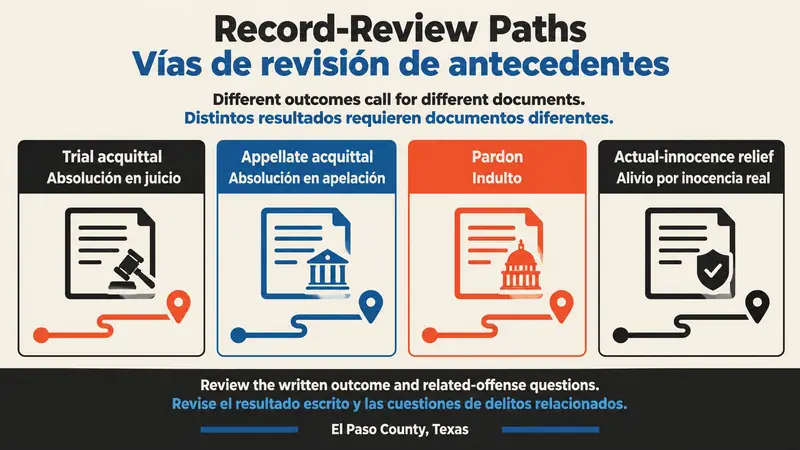
A post-acquittal expunction review starts with the exact disposition, the arrest transaction, and the controlling Texas statute—not just a docket label that says “not guilty.” Current Chapter 55A creates mandatory pathways after a trial-court acquittal and after a qualifying pardon or other relief based on actual innocence. It also provides a separate, discretionary route when an appellate court acquits after a conviction. The differences affect the court, the proof, the timing, and the risk created by related offenses.
Traffic Tickets 915 serves people with El Paso County matters and nearby communities including Socorro, Horizon City, Canutillo, and San Elizario. This original page is general legal information verified as of September 2026, not individualized legal advice. A focused case review can compare the arrest paperwork, charging record, verdict or mandate, pardon documents, and all related cases before a petition or proposed order is submitted.
Texas recognizes different post-trial record-clearing routes
Article 55A.002 entitles a person arrested for a felony or misdemeanor to expunction of arrest-related records after a trial-court acquittal, subject to the criminal-episode bar. Under Article 55A.201, the trial court—or a district court in that county when necessary—must enter the order on the acquitted person’s request after notice to the state, or on the state’s request with consent. The statute sets a 30-day court-action deadline after acquittal and requires the trial court to advise the person of the right.
A pardon can also support relief. Article 55A.004 covers a conviction followed by a pardon for a reason other than actual innocence. Article 55A.003 covers a pardon or other relief based on actual innocence only when the document states that basis on its face. For that route, Article 55A.202 directs entry of an order within 30 days after the court receives notice; the person must provide petition-type identifying and case information.

An appellate acquittal is not handled exactly like a trial acquittal
After a conviction, an acquittal by the Court of Criminal Appeals—or by a court of appeals after the time for discretionary review expires—falls under Article 55A.101. The eligible court may expunge the arrest records; this is discretionary, not the mandatory trial-acquittal process. The review should include the appellate opinion, mandate or other finality proof, and the judgment history.
Article 55A.151 blocks expunction after a trial or appellate acquittal if the acquitted offense arose from the same criminal episode as another offense that ended in conviction or remains prosecutable. That differs from unrelated history. Article 55A.152 generally excludes driver-license suspension or revocation records, except under specified Transportation Code provisions. A favorable result on one count is not enough to assess the whole arrest.

The supporting proof must fit the statutory pathway
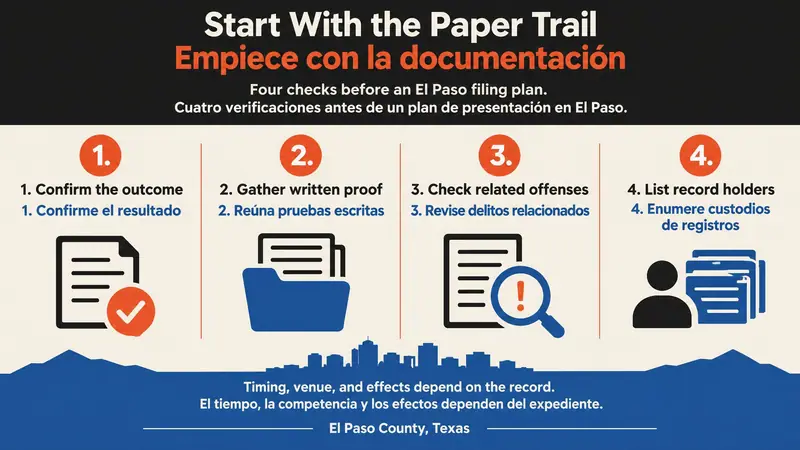
Proof must match the route. A trial-acquittal review needs the judgment and case information; an appellate route needs final appellate materials. For pardon or actual-innocence relief, the controlling pardon or order is crucial, and Article 55A.003 requires an express actual-innocence statement on its face. An informal description such as “exoneration” cannot replace the operative document.
An ordinary verified petition must provide identifying and case details, or explain what is unavailable: charged offense, alleged offense date, arrest date, arresting agency, location, court, case number, and relevant entities. It may identify federal repositories and paid criminal-history companies the person has reason to believe hold covered records. Accurate information supports notice and follow-up.
El Paso County timing and filing require a concrete plan
Article 55A.251 generally allows an ex parte petition in district court where the arrest occurred or the offense was alleged; fine-only matters have a limited justice-court or municipal-court-of-record option. The El Paso County District Clerk publishes expunction materials and e-filing information. Confirm current fees, service charges, and local practices directly with the clerk because they can change.
For a petition requiring a hearing, Article 55A.254 sets the hearing no earlier than 30 days after filing and requires notice to listed entities. That scheduling rule is not a reason to delay. A fresh acquittal, appellate mandate, pardon notice, job application, or licensing response can make prompt records collection important. Request a case review before a deadline so the route and record list can be checked.
- Collect arrest, charging, docket, judgment, verdict, appellate, pardon, or actual-innocence documents.
- Make a timeline from arrest through trial, appeal, pardon notice, and outside deadlines.
- Check every same-event or criminal-episode offense for a conviction, pending case, or possible prosecution.
- Identify likely holders: arresting agency, jail, prosecutor, court, clerk, DPS, and known private background companies.
- Confirm court, e-filing, notice, service charges, and whether the process is automatic or petition-based.
A final order has meaningful effects but practical limits
After a general Chapter 55A order is final, Article 55A.401 prohibits release, maintenance, dissemination, or use of the expunged records and ordinarily permits denial of the arrest and order. If questioned under oath in a criminal proceeding, however, the person may say only that the matter was expunged. Keep a certified signed order and verify the result through appropriate channels.
An expunction does not promise that every reference disappears everywhere or immediately. Article 55A.301 directs state agencies that sent information to central federal repositories to request return of covered materials, while Article 55A.302 permits defined retention, including certain acquittal-related records needed for another investigation or case. Federal, immigration, licensing, private-data, and security questions can involve separate rules.
FAQ
Frequently asked questions
Does a not-guilty verdict automatically clear an El Paso arrest record?+
No. Article 55A.201 directs an order within 30 days after a qualifying trial-court acquittal, but the required information and criminal-episode analysis still matter. Confirm that a signed order was entered.
Can an appellate acquittal support an expunction in Texas?+
Possibly. Article 55A.101 permits an eligible court to expunge after the specified appellate acquittal and finality of review. It is discretionary and subject to the same-criminal-episode limitation.
Is any pardon enough for an expunction?+
Texas distinguishes pardons. Article 55A.004 covers a pardon for a reason other than actual innocence; Article 55A.003 covers actual-innocence relief only when the document says so on its face.
What proof matters for actual-innocence expunction?+
The operative pardon or court order, expressly stating actual innocence where Article 55A.003 is used, is essential. The court also needs the identifying, arrest, case, court, and agency information required by Article 55A.253.
Will an expunction eliminate every background-check or licensing concern?+
Do not assume it will. A final Texas order has significant effects on covered records, but private databases, federal systems, licensing, immigration, retention rules, and exact disclosure questions may be separate matters.
El Paso County record-relief help
Official Texas and El Paso resources
These official and nonprofit sources provide general information. Forms, fees, procedures, and statutes may change.