

When you look for help clearing a record in El Paso, begin with the difference between an arrest record and a result you can prove in court. A dismissal, deferred adjudication, or old case may raise a record-clearing question, but none automatically establishes eligibility. Traffic Tickets 915 reviews the arrest, every charge tied to it, the final disposition, dates, later history, and the current Texas statute before identifying a possible next step for clients in El Paso County, Socorro, Horizon City, and nearby communities.
This hub explains the two remedies most often confused in Texas: expunction under Code of Criminal Procedure Chapter 55A and an order of nondisclosure under Government Code Chapter 411, Subchapter E-1. It is general information, not a prediction about a particular case. A court order may have important legal effects, yet it should never be marketed as a guarantee that information will vanish from every private database, federal system, immigration record, news archive, licensing file, or background-check product.
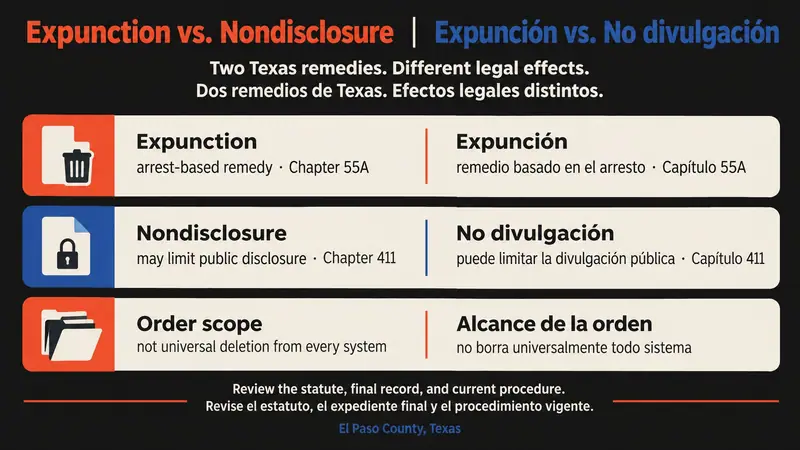
Texas expunction and nondisclosure are not the same remedy
An expunction is an arrest-based remedy governed by Chapter 55A. Depending on the statutory route and facts, it can be relevant after an acquittal, pardon, certain arrests with no filed charge, certain dismissals, or a qualifying Class C misdemeanor deferred-adjudication matter. The rule is narrower than the everyday phrase “clear my record.” A conviction ordinarily does not become expunction-eligible merely because time has passed, and one arrest can involve more than one allegation that must be analyzed together.
A nondisclosure order is often called record sealing, but it works differently. When the statutory conditions are met, it generally restricts public disclosure of criminal-history record information about the covered offense; it is not a deletion order for every record connected to a person. Different Chapter 411 provisions cover different situations, including certain deferred-adjudication matters, DWI-related matters, and other specialized paths. Criminal-justice agencies and entities specifically authorized by statute may still receive information, so the exact route and scope matter.

Start with the result of the case, then test the statutory route
The right question is not simply whether the case was dismissed. For an expunction assessment, the review may include why a charge ended, whether a prosecutor could still proceed, the statute of limitations for every offense arising from the arrest, and whether another disposition from that arrest affects relief. For an arrest without a filed charge, Chapter 55A contains timing rules; the statute can also allow a limited form of relief before limitations expires in defined circumstances. A case-specific timeline is safer than counting backward from a vague memory of the court date.
For nondisclosure, the case type and entire criminal history can be just as important as the requested offense. State Law Library and TexasLawHelp materials identify broad disqualifying categories, including offenses requiring sex-offender registration, family-violence matters, and certain listed serious offenses. A conviction or deferred adjudication during an applicable waiting period can also matter, subject to the specific provision. Some first-time misdemeanor cases use an automatic-order mechanism, while other matters require a petition; neither label removes the need to verify the statutory conditions and court record.

Build an accurate El Paso County record-clearing file
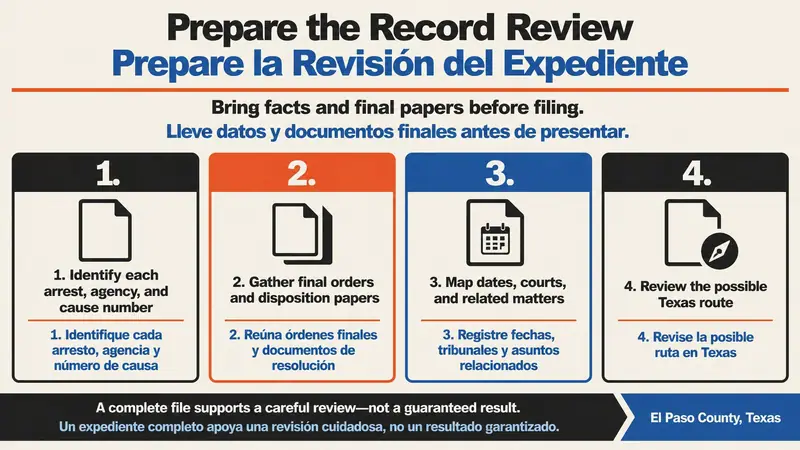
Before a petition is drafted, identify the court, arresting agency, cause number, dates, every charge, and every final order. Useful records can include the arrest report or booking information, charging instrument, docket, judgment, dismissal or acquittal order, discharge paperwork, and a Texas criminal-history record. Names, dates of birth, aliases, and agency identifiers deserve careful attention. Incomplete information can lead to a petition or proposed order that does not accurately describe the arrest or reach every government record holder that the statute requires to be notified.
El Paso County lists expunction among matters handled by the District Clerk’s Civil Division and provides civil-case, e-filing, and self-help links. That local administrative information does not decide venue, eligibility, or which Chapter 411 form applies. The clerk cannot give legal advice. A well-prepared review separates local filing mechanics from legal analysis, confirms the current fee schedule and court practice, and identifies whether another county, court, or agency has a record that should be considered before documents are filed.
- Write down each arresting agency, court, cause number, arrest date, charge, and final outcome; do not rely on one online docket screen.
- Collect certified final orders where available, especially dismissals, acquittals, judgments, and discharge documents.
- Request or review Texas criminal-history information and disclose prior matters, including matters under a different name.
- Keep a calendar of known filing, waiting-period, licensing, employment, or immigration deadlines, then request a review before acting.
- Confirm current El Paso County filing procedures and fees rather than treating a prior form or internet checklist as current law.
Understand what an order can do—and what it may not reach
A signed order is an important legal event, but it is not a universal eraser. Under Chapter 55A, eligible agencies are directed to handle records as the statute and order require. Under nondisclosure law, the public-disclosure restriction has statutory exceptions. The practical result can differ from what a commercial website displays, and a court order does not control a person’s memory, a news story, a privately maintained website, or every third-party data product. Do not state that a record is “gone everywhere” before understanding the order’s language and the systems involved.
State record relief can also coexist with separate disclosure duties. TexasLawHelp cautions that immigration forms may still require disclosure of arrests or criminal matters even after an expunction or nondisclosure order. Similar care may be needed for federal proceedings, security-clearance questions, professional licensing applications, or forms signed under oath. The accurate approach is to obtain advice from a lawyer in the relevant area before answering a specialized question; this hub does not tell any reader how to answer a particular application.
Use this hub to reach the right Traffic Tickets 915 service page
Record clearing is often connected to an unresolved local court issue. If a current traffic citation or Class C matter still needs attention, visit the Traffic Tickets 915 traffic-ticket page at /traffic-ticket-lawyer before assuming a record-relief remedy is available. If you learned of a failure-to-appear warrant, capias, or other warrant concern while researching your history, use /warrant-lawyer to focus first on the issuing court and the underlying case. Neither a ticket nor a warrant is automatically an expunction matter, but prompt review can help prevent a deadline from being missed.
A license suspension or other driving limitation is also a separate issue from an expunction or nondisclosure. The occupational driver license page at /occupational-drivers-license-attorney addresses that distinct court-and-DPS process. Call Traffic Tickets 915 or request a bilingual case review before a court date, filing deadline, job-related deadline, or planned application. The goal is a candid assessment of what documents are needed, which remedy may be worth exploring, and what relief cannot responsibly be promised.
FAQ
Frequently asked questions
Is a Texas expunction the same as sealing a record?+
No. Expunction is the Chapter 55A remedy for qualifying arrest-related records. Nondisclosure under Chapter 411 generally limits public disclosure of information about an eligible covered offense, while authorized entities may retain statutory access. The facts and legal effect must be reviewed separately.
Can a dismissed case be expunged in El Paso County?+
Possibly, but a dismissal alone does not answer the question. The reason for dismissal, all offenses from the arrest, limitations issues, the final disposition, and other statutory conditions can matter. Obtain the final papers and request a review before filing.
Does deferred adjudication qualify for expunction?+
A qualifying Class C misdemeanor deferred-adjudication matter may fit an expunction route. Other deferred-adjudication cases are commonly evaluated for the appropriate nondisclosure route. The offense, discharge date, complete history, and statutory exclusions can change the analysis.
Will an order remove every background-check result?+
No such promise is responsible. An order can affect government-held criminal-history information as the applicable law provides, but it may not erase private databases, archived reporting, federal records, or every specialized disclosure duty. Ask what the particular order reaches.
Where should I file an El Paso County expunction?+
El Paso County identifies expunction as a civil matter handled through the District Clerk’s Civil Division, but the correct venue and filing path depend on the arrest and statute. Confirm the current court, notices, forms, fees, and timing before submitting a petition.
El Paso County record-relief help
Official Texas and El Paso resources
These official and nonprofit sources provide general information. Forms, fees, procedures, and statutes may change.